Official EAU project website: eau-meta-agent.github.io · alphaXiv (arXiv:2610.16523).

Learning to
evolve, together.

Environment–Agent–User Co-evolution
for Training User-Centric Agents

EAU is a meta-agent framework that evolves the environment, the agent, and the simulated user together while training user-centric agents.

Three parts. One evolving system. Environment, agent, and user form a connected cycle around a meta-agent. Feedback from training informs the next intervention. Environment Agent User META-AGENT Observe. Adapt. Learn. Repeat.
Fig. 01Three parts. One evolving system.

Min Cai1,*Dan Zhang2,*Gao Xing3Libin Ma3Zhaohui Xu4Xi Ye1,5

1 University of Alberta2 National University of Singapore3 Kuaishou Technology4 Independent Researcher5 Amii

* Equal contribution

01 / The idea

What does EAU
adapt?

EAU co-evolves the environment, agent, and simulated user to train user-centric LLM agents.

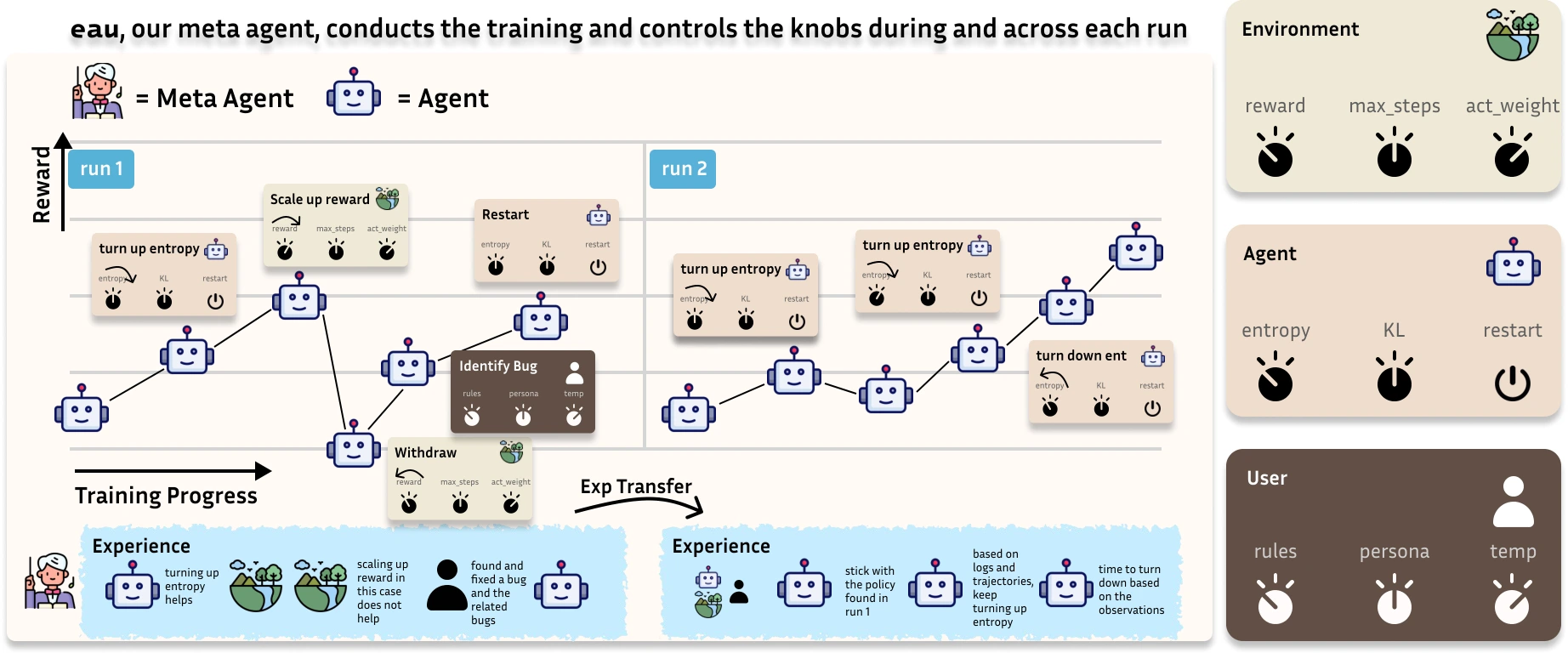
For multi-turn reinforcement learning with users and tools, its meta-agent reads trajectories, tool traces, and training statistics. It proposes and validates changes to the hybrid user simulator, environment feedback, reward design, and reinforcement-learning configuration.

Within a run, supported updates take effect while the agent policy learns. Across runs, an experience pool carries findings into later training attempts. Final-test feedback stays outside the adaptation loop.

EAU is evaluated on UserGym, ColBench, and τ²-bench with Qwen3-4B and Qwen2.5-7B-Instruct. The reported results describe these benchmark settings, not a guarantee for every agent environment.

See how co-evolution works
+36.7%

Relative gain in ColBench task successQwen3-4B · vs. InfoPO

+15.0%

Relative gain in overall scoreQwen3-4B · UserGym + ColBench

3 / 2

Interactive benchmarks / policy backbonesQwen3-4B · Qwen2.5-7B-Instruct

02 / The framework

How EAU adapts
the training system.

The policy learns through reinforcement learning.
The meta-agent adapts the experience it learns from.

More controllable conversations.

Combine explicit symbolic rules with natural LLM responses. The meta-agent can revise disclosure rules, persona instructions, generation settings, and the mixture between the two simulators.

Symbolic rulesMixing coefficient εUser persona
THE TRAINING SYSTEM
EnvironmentTools & rewards
AgentNeural policy
UserHybrid simulator
eau meta-agentObserve → diagnose → intervene
Experience
across runs ↗

Training feedback guides adaptation.
Final-test feedback stays outside the loop.

Evolving environment

A more informative learning signal.

Revise intermediate rewards when task success is too sparse to guide exploration. The meta-agent can reward meaningful progress, correct unhelpful reward designs, and adjust supported interaction limits.

Intermediate rewardsReward rulesEpisode length
Evolving agent

Training dynamics that can adapt.

The neural policy learns through PPO with an action-token critic. The meta-agent monitors optimization logs and trajectories, adjusting configurable dynamics such as entropy and KL coefficients while keeping the training algorithm fixed.

Entropy coefficientKL coefficientTraining diagnostics
Within a run

Adapt in the moment.

Hot-swap supported user rules, reward designs, and training settings as the policy changes.

Across runs

Keep what you learn.

Consolidate findings in an experience pool. Restart when needed and build on earlier discoveries.

View the framework figure from the paper
EAU framework from the manuscript, showing meta-agent interventions on environment, agent, and user knobs during and across training runs.
The meta-agent controls editable knobs and carries experience between runs. Figure from the supplied manuscript.

03 / The evidence

EAU results on
UserGym and ColBench.

Evaluated on UserGym, ColBench, and τ²-bench.
Explore the results across two policy backbones.

InfoPO eau

UserGym

+11.4%

Average score

ColBench

+36.7%

Successful task completion

Overall

+15.0%

UserGym + ColBench

Higher is better. Relative gains compare eau with InfoPO. Overall scores aggregate UserGym and ColBench under the paper’s evaluation protocol.

Compare all reported methods
Qwen3-4B · UserGym and ColBench
MethodUserGym avg.ColBench passColBench successOverall
Backbone0.4260.2720.1530.378
ReAct0.4570.2690.1450.401
Reflexion0.4550.3030.1840.408
RAGEN0.4680.4790.3610.457
Search-R10.4720.4670.3550.459
UserRL0.5090.4680.3420.486
InfoPO0.5590.5530.4390.545
PPO0.5220.2840.2000.462
eau0.6230.6850.6000.627
Another interactive setting

Generalizing to τ²-bench.

On Qwen3-4B, eau reaches an aggregate score of 21.5, compared with 18.5 for PPO. It leads on Airline and Telecom; InfoPO leads on Retail.

21.5vs. 18.5 PPO
+16.2% relative gain

04 / A closer look

Experience becomes
part of the system.

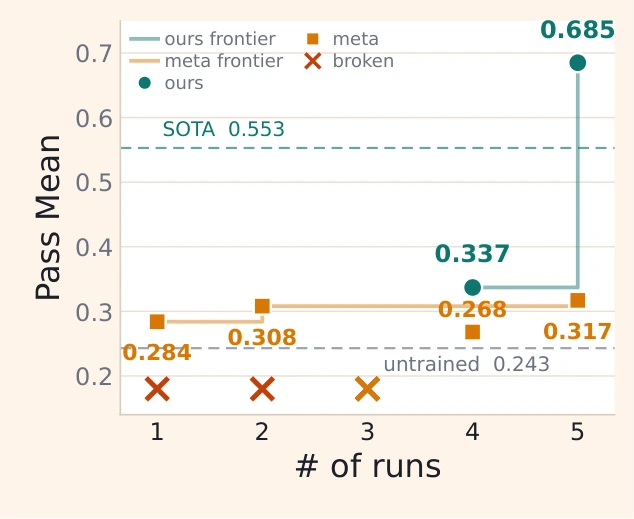
ColBench best-score frontier: EAU reaches pass mean 0.685, compared with 0.317 for a generic meta-agent, over five runs.
01 / Learning from interventions

Every run leaves something useful.

After diagnosing severe issues and restarting early runs, eau explores interventions within a run and carries the findings forward. The resulting frontier improves beyond the generic meta-agent in this experiment.

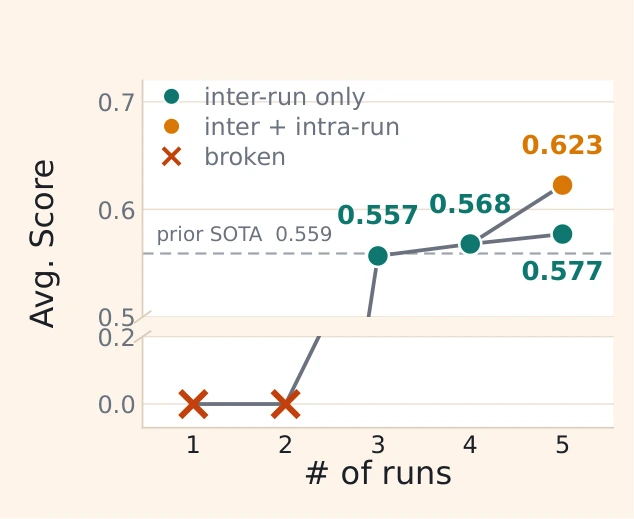
UserGym progression: with shared experience from the first four runs, adding intra-run intervention reaches 0.623 versus 0.577 with inter-run adaptation alone.
02 / Adapting at two timescales

Timing is part of the method.

Starting from the same first four runs of experience, adding within-run intervention reaches 0.623 on UserGym, compared with 0.577 for between-run adaptation alone.

These curves show progression by run count, rather than a comparison under matched total compute. Evaluation conditions remain fixed while the training system evolves.

05 / Continue exploring

Read, reproduce,
build on it.

Environment–Agent–User Co-evolution
for Training User-Centric Agents

Cite this work
@misc{cai2026eauenvironmentagentusercoevolutiontraining,
  title = {EAU: Environment-Agent-User
    Co-evolution for Training
    User-Centric Agents},
  author = {Min Cai and Dan Zhang and
    Gao Xing and Libin Ma and
    Zhaohui Xu and Xi Ye},
  year = {2026},
  eprint = {2610.16523},
  archivePrefix = {arXiv},
  primaryClass = {cs.AI},
  url = {https://arxiv.org/abs/2610.16523}
}